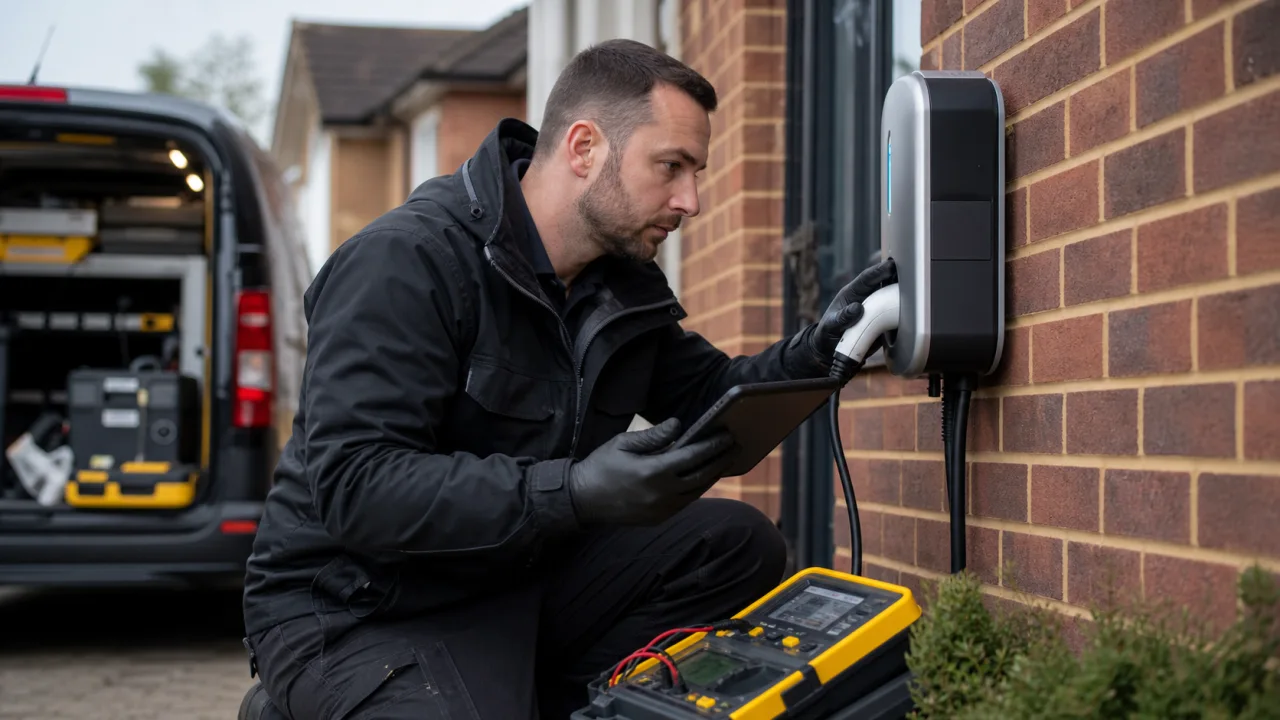
Electrician SEO costs £400 to £1,500 per month in the UK, and the work that produces enquiries fastest is Google Business Profile management combined with separate pages for the distinct jobs electricians actually get hired for: EICR reports, consumer unit replacement, EV charger installation and rewiring.
Each is a different search with different urgency and a different buyer, so a single electrical services page competes for none of them. NICEIC or NAPIT registration displayed with the certificate number is the strongest trust signal available, because Part P of the Building Regulations makes competent person registration the thing customers are told to check. Landlord EICR work recurs on a five-year cycle under the Electrical Safety Standards regulations, which makes those customers unusually valuable. Most electricians see enquiry movement within three to six months of consistent local work.
Last updated: 22 August 2026
Electrical work has an unusual buying pattern. Half the demand is unplanned and urgent, half is compliance-driven and scheduled months ahead, and the two audiences behave nothing alike. A landlord booking an EICR before a tenancy starts and a homeowner with no power in half the house are not the same customer, and one page cannot serve both.
- How much does electrician SEO cost?
- Which electrical jobs should have their own page?
- Why is EV charger installation worth targeting?
- How do landlord compliance searches work?
- What trust signals matter most for electricians?
- How should an electrician handle emergency callouts?
- What should an electrician website include?
- How do customers use AI to find an electrician?
- How should an electrician approach commercial contracts?
- How should an electrician handle rewiring enquiries?
- Frequently asked questions
- Related reading
How much does electrician SEO cost?
Electrician SEO costs £400 to £1,500 per month in the UK. A sole trader competing in one town sits at £400 to £700. A firm with several electricians covering multiple towns and commercial work sits at £700 to £1,500. Most see enquiry movement within three to six months.

Electrical search is moderately competitive locally but has genuine gaps in the compliance and EV segments, where demand has grown faster than the supply of well-optimised local pages. Those gaps are where a smaller firm can realistically compete.
| Focus | Monthly cost | Competition | Best entry point |
|---|---|---|---|
| Emergency callouts | £400-£700 | High locally | Map pack and answered phone |
| Landlord EICR compliance | £500-£900 | Moderate | Fixed-price EICR page, recurring cycle |
| EV charger installation | £600-£1,100 | Low to moderate | Buyer guidance content |
| Commercial and periodic testing | £800-£1,500 | Low | Compliance pages per obligation |
Which electrical jobs should have their own page?
Give each distinct job its own page, because customers search for the job rather than for electrical services generally. Someone needing an EICR searches for an EICR, not for an electrician, and lands on whichever page addresses that exact need.
- EICR and electrical safety certificates - landlord-driven, compliance-led, and repeatable on a five-year cycle, which makes the customer relationship recurring.
- Consumer unit replacement - mid-value job with a clear price range, often triggered by a failed EICR or an insurance requirement.
- EV charger installation - fastest-growing electrical work, with buyers who research thoroughly before committing.
- Full and partial rewiring - highest job value, long consideration period, and the segment where cost guidance matters most.
- Emergency electrician callouts - immediate intent, decided by map pack position and an answered phone rather than by page quality.
- Commercial and periodic inspection - business customers with recurring obligations and considerably higher lifetime value.
If your electrical business runs one services page listing everything, that is why it ranks for nothing specific. Splitting it is a content exercise rather than a rebuild - see our AI SEO service.
Why is EV charger installation worth targeting?
EV charger installation is the strongest growth segment in domestic electrical work, and buyer behaviour favours well-informed suppliers. Customers research charger types, grant eligibility and installation requirements before contacting anyone, which rewards the firm that answers those questions publicly.
The research-heavy pattern is what makes it winnable. Unlike an emergency callout decided in ninety seconds, an EV charger buyer reads several pages over several days. A firm explaining tethered versus untethered chargers, load management requirements, the difference between 7kW and 22kW installation, and what affects the price becomes the trusted option before any conversation happens.
Grant and scheme eligibility changes periodically, and content covering it needs genuine maintenance rather than being published once. Publishing superseded grant information is worse than publishing none, because it creates a specific expectation the customer discovers is wrong.
How do landlord compliance searches work?
Landlord compliance searches are deadline-driven and repeat on a fixed cycle. Electrical Safety Standards regulations require an EICR at least every five years for rented properties in England, and landlords search when a tenancy is changing or a report is expiring.
The recurrence is the commercial opportunity. A landlord who books an EICR is a customer with a known return date, and one with a portfolio is a customer with recurring work across several properties. Winning that customer once is worth considerably more than a single job.
What should an EICR page state?
An EICR page should state the price, what the inspection covers, how long it takes and what happens if the property fails. Landlords want the cost and the consequence, not an explanation of why electrical safety matters.
Failure handling is the question landlords most want answered and most pages ignore. Explaining that a report classified as unsatisfactory requires remedial work within 28 days, that the firm can quote for that work, and roughly what common remedial items cost, addresses the actual anxiety. A landlord choosing between two firms picks the one that already explained what happens if things go wrong.
What trust signals matter most for electricians?
Competent person scheme registration is the decisive trust signal, because Part P of the Building Regulations means customers are explicitly advised to check it. NICEIC, NAPIT, ELECSA or equivalent registration should appear with the actual registration number.
The number matters more than the logo. Registration logos are trivially copied and customers have become sceptical of them, whereas a registration number can be verified on the scheme register. Publishing the number invites verification, which is precisely the signal a legitimate firm wants to send.
Part P self-certification is worth explaining rather than merely claiming. Most homeowners do not know that certain electrical work must be notified to building control, or that a registered electrician can self-certify and save them a separate application and fee. A firm explaining this demonstrates competence and creates a concrete reason to choose a registered installer over a cheaper unregistered one.
How should an electrician handle emergency callouts?
Emergency electrical work is won on map pack position and an answered phone rather than website quality, the same dynamic that governs roofing SEO. Someone with no power or a burning smell from a socket calls the first two or three numbers and instructs whoever can attend soonest.
Callout charges should be stated openly. Customers in an emergency fear an unbounded bill more than a specific one, and a firm publishing its callout fee and hourly rate converts better than one leaving it unstated. The transparency also filters out the price-shopping calls that waste time during a busy period.
What should an electrician website include?
An electrician website needs registration verification, job-specific pages, published price ranges and a phone number visible without scrolling on mobile. Everything else is secondary.
- Display the scheme registration number - NICEIC, NAPIT or equivalent with the number itself so customers can verify it on the scheme register.
- Publish price ranges by job - EICR, consumer unit, EV charger and rewire all have predictable ranges that pre-qualify enquiries.
- Show the phone number prominently - visible on mobile without scrolling, since emergency callers will not hunt for it.
- State the service area honestly - the towns genuinely covered, since proximity drives local ranking and aspirational coverage produces calls that must be declined.
- Add completed work photographs - consumer units and EV installations photograph well and demonstrate workmanship standards.
- Test the enquiry form monthly - a silently broken form on a trades site is invisible until the diary empties.
How do customers use AI to find an electrician?
Customers ask AI assistants what electrical work should cost, whether a job requires a registered electrician, and what to check before hiring. The opportunity is being the source those answers draw from rather than being recommended directly.
Compliance questions dominate, which suits electricians well. Whether a consumer unit change needs building control notification, whether an EICR is legally required, and what a Part P certificate covers are all questions with definite answers that a registered firm can state authoritatively. Publishing them clearly makes the firm citable on exactly the queries that precede hiring.
How should an electrician approach commercial contracts?
Commercial electrical work is won on compliance evidence and reliability rather than price, and it recurs. Periodic inspection obligations, emergency lighting testing and PAT testing all run on fixed cycles, which turns a single commercial client into predictable annual revenue.
The buyer is different in a way that changes the whole page. A facilities manager or landlord procuring electrical maintenance is assessing whether the contractor can produce documentation, attend within an agreed response time and carry adequate insurance. They are not comparing hourly rates in the way a homeowner does.
Response time commitments are frequently the deciding factor. A commercial client with a building full of staff needs to know that a fault will be attended within a stated window, and a contractor publishing that commitment differentiates immediately from one who does not mention it.
What commercial services should have their own pages?
Periodic inspection and testing, emergency lighting, fire alarm systems and PAT testing each warrant a page, because facilities managers search for the specific compliance obligation they need to discharge rather than for an electrician.
Each page should state the testing frequency the regulations require, what the certificate covers and what happens when remedial work is identified. A facilities manager reading a page that already explains their own obligation is dealing with a contractor who understands the sector, which shortens the procurement conversation considerably.
How should an electrician handle rewiring enquiries?
Rewiring is the highest-value domestic electrical job and the most researched, so the page needs cost ranges by property size, a realistic disruption description and an explanation of what triggers a full rewire rather than partial work.
Disruption is the homeowner primary anxiety, ahead of cost. A full rewire involves lifting floorboards, chasing walls and living without power in parts of the house for days. A page setting out what actually happens day by day, and whether the property remains habitable, addresses the fear that stops people commissioning work they know they need.
Partial rewiring deserves separate explanation because many properties do not need a full one. A firm explaining when partial work is sufficient, and being willing to say so, builds more trust than one presenting a full rewire as the only option. Homeowners recognise the difference between advice and a sales pitch.
What should a rewiring cost page include?
Include ranges by bedroom count, the factors that move a quote, and what is excluded such as making good plaster and redecoration. Homeowners routinely assume decoration is included and are unpleasantly surprised at the end.
Explaining the exclusions in advance prevents most rewiring disputes. A page stating that the quote covers electrical work and basic making good, but not plastering or decoration, sets the expectation early and positions the firm as straightforward rather than as having concealed something.
Frequently asked questions
Should an electrician list every town they cover?
List only the towns genuinely served within a workable travel radius. Proximity is a strong local ranking factor, so distant towns rarely rank however many pages exist, and listing them generates calls that must be declined. Honest coverage of six towns beats aspirational coverage of thirty.
How should an electrician handle EV charger grant questions?
State current eligibility plainly and review the page whenever schemes change. Grant terms have shifted several times, and publishing superseded information creates a specific expectation the customer discovers is wrong, which damages trust more than saying nothing.
How long does electrician SEO take to produce enquiries?
Map pack improvements from profile and review work often show within four to eight weeks. Job-specific page ranking takes three to six months. Compliance and EV segments typically move faster than general electrician terms because competition is thinner.
Should an electrician target commercial or domestic work?
Both, on separate pages, because the buyers are entirely different. Commercial customers search for periodic inspection and maintenance contracts with recurring value; domestic customers search by individual job. Mixing them on one page serves neither.
Do electricians need to publish prices?
Publish ranges rather than fixed prices for variable work, and fixed prices for standardised jobs such as EICRs where the scope is predictable. Ranges with the factors that move them reduce wasted quoting and position the firm as straightforward.
How important are reviews for electricians?
Substantially important, because customers cannot assess electrical competence and are aware that bad electrical work is dangerous. Review count and recency also feed local ranking directly, which decides emergency work.
Which competent person scheme is best to display?
Any recognised scheme carries weight, including NICEIC, NAPIT and ELECSA. What matters is displaying the registration number so customers can verify it, rather than which scheme it is. Logos alone carry less weight than verifiable numbers.
Is it worth an electrician bidding on lead generation platforms?
Generally poor value, because the same enquiry is sold to several firms and becomes a price race. The same monthly spend put into profile management and job-specific pages produces exclusive enquiries that compound over time.
Related reading
Electrician SEO costs £400 to £1,500 monthly in the UK and works best when the site is split by job rather than presenting general electrical services. EICR, consumer unit replacement, EV charger installation and rewiring are separate searches with separate buyers, urgency levels and price expectations. Competent person scheme registration displayed with the actual number is the strongest available trust signal, because Part P of the Building Regulations directs customers to check it. Landlord compliance work recurs on a five-year cycle under the Electrical Safety Standards regulations, making those customers unusually valuable. Emergency work is decided by map pack position and an answered phone rather than by website quality.
Getting found for callouts but not for EICRs or EV chargers? We review electrical business visibility across the map pack and job-specific pages. See our AI SEO service or book a call.
Written by the Transformation Junction SEO team. Cost figures are market estimates drawn from published UK agency pricing, not measured client data; regulatory and platform requirements are sourced below. Drafted with AI assistance and reviewed by a named editor before publication; see our editorial policy on the About page.
Sources