What should a website project checklist cover?
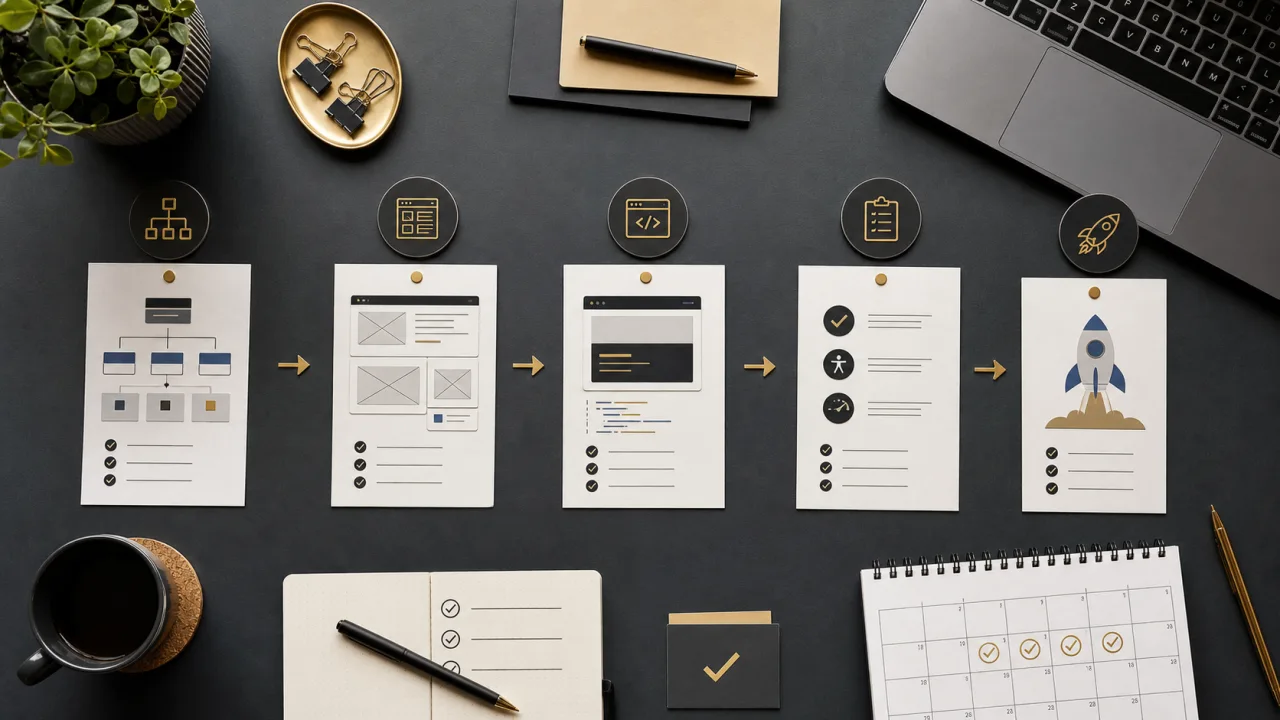
A complete website project checklist covers six stages: discovery and requirements, the design brief, content preparation, technical build, pre-launch checks, and post-launch monitoring. Most failed website projects skip discovery and content, then discover the gap halfway through the build when it is expensive to fix.

Stage 1: What do you need before briefing anyone?
Answer these before you speak to a single agency. Vague answers here produce vague quotes, and vague quotes produce disappointing websites.
- What is the single primary action a visitor should take?
- Who is the visitor, and what do they need to believe before acting?
- What does a lead or sale from this website need to be worth to justify the build?
- What is genuinely different about this business, in words a customer would recognise?
- Who owns the content, and when will it actually be ready?
- What must migrate from the existing site, and what should be retired?
The content question is the one that derails projects. Agencies are ready to build long before clients are ready with copy, and the project stalls in a half-finished state for months.
Stage 2: What goes in a web design brief?
A brief that produces comparable quotes needs specifics, not adjectives. "Modern and clean" tells a designer nothing, because every designer believes their work is modern and clean.
- Business background and target customer
- Primary conversion and secondary conversions
- Page list, or an approximate page count with a rough sitemap
- Functionality: forms, booking, payments, logins, integrations
- Content: who writes it, who supplies images, what already exists
- Three websites you like and, more usefully, what specifically you like about each
- Brand assets available: logo files, fonts, colours, photography
- Budget range and required launch date
- Who signs off, and how many review rounds are included
That last point prevents more disputes than any other line in a brief.
Stage 3: What content does a business website need?
Most business sites need fewer pages than people expect, built better. A focused eight-page site outperforms a scattered thirty-page one.
Core pages
- Homepage
- One page per service, not a single combined services page
- About, with real people and real credentials
- Contact, with address, phone, email and a form
- Proof: case studies, testimonials or results
Legal pages every UK business site needs
- Privacy policy, covering UK GDPR obligations
- Cookie policy and a compliant consent mechanism
- Terms and conditions
- Accessibility statement
- Company registration number, registered address and VAT number where applicable
The company number and registered address are a legal requirement for UK limited companies under the Companies Act, not an optional extra. A surprising number of small business sites omit them.
Stage 4: What technical work happens during the build?
- Mobile-first responsive layout, tested on real devices rather than a browser resize
- Core Web Vitals: loading, interactivity and layout stability
- Image compression and modern formats
- HTTPS across the whole site with no mixed content
- Semantic heading structure, one H1 per page
- Descriptive alt text on every meaningful image
- Keyboard navigation and visible focus states
- Colour contrast meeting WCAG AA
- Schema markup matching the visible page content
- Analytics and conversion tracking, tested with real submissions
Stage 5: What must be checked before launch?
This is the stage that gets rushed, and it is the stage where the expensive mistakes hide.
- Test every form end to end. Submit each one and confirm the notification actually arrives in the right inbox. A form that silently fails looks identical to a form nobody used.
- Check redirects from every old URL to its new equivalent
- Confirm the site is not blocking search engines in robots.txt, a common leftover from staging
- Verify the XML sitemap generates and submits
- Test on real phones, not just desktop
- Check every internal and external link
- Confirm analytics fires and conversion goals record
- Verify SSL, including the certificate expiry date
- Check page titles and meta descriptions are unique and present
- Confirm backups are running
The form test deserves its position at the top. A broken contact form is the single most expensive website fault, because it produces no error, no complaint and no evidence. The business simply stops receiving enquiries and assumes demand has fallen.
Stage 6: What happens after launch?
- Submit to Google Search Console and Bing Webmaster Tools
- Monitor indexation for the first month
- Watch for crawl errors and broken redirects
- Check Core Web Vitals on real traffic
- Review actual conversion data against expectations
- Schedule ongoing updates, security patching and backups
Frequently asked questions
How long should a business website take to build?
Six to twelve weeks for a standard business site, assuming content is ready. Content delays are the most common cause of overrun. Ecommerce and custom functionality extend this considerably.
Who should write the website content?
Someone who understands the business and can write. That may be internal, or a copywriter briefed properly. What does not work is assuming the web designer will write it, unless that is explicitly in scope and priced.
What are the legal requirements for a UK business website?
UK limited companies must display the registered company name, number and registered office address. Sites processing personal data need a UK GDPR-compliant privacy policy and cookie consent. Ecommerce sites have additional obligations on pricing, delivery and returns under consumer contract regulations.
Does a new website hurt existing rankings?
It can, if URLs change without redirects. A properly mapped redirect plan preserves most ranking equity. Rebuilding without a redirect map is the most common cause of traffic collapse after a redesign.
How many review rounds should a website project include?
Two or three is typical. Agree the number in writing before starting, along with what counts as a revision versus a scope change. Unlimited revisions sound generous and usually end badly for both sides.
The short version
Website projects fail on planning and content, not design. Answer the discovery questions before briefing. Write a brief with specifics rather than adjectives. Have content ready before the build starts. Cover the legal pages, including the company number UK limited companies are required to display. And before launch, submit every form and confirm the notification arrives, because a silently broken form costs more than every other fault combined.