Checking whether AI mentions your business means testing five platforms, ChatGPT, Perplexity, Google AI Overviews, Copilot and Claude, using prompts built from your trading name, service and town; the check takes under 20 minutes. In an April 2026 audit of 50 UK small businesses, 62 per cent appeared in none of the five, and 32 per cent had AI crawlers blocked.
Last updated: 29 June 2026
Most business owners assume they are invisible in AI search because they have not done enough marketing. The real pattern is different. In the majority of cases we diagnosed in 2026, the business had functioning Google rankings but one unnoticed CDN setting was silently blocking the AI crawlers that ChatGPT and Perplexity depend on. The problem is not promotion. It is a single checkbox most owners have never opened - and it takes about 90 seconds to fix once you know it exists.
How to Check if AI Mentions Your Business- How do you check if ChatGPT or Google AI Overviews mentions your business right now?
- What did we find when we audited 50 UK small businesses for AI visibility?
- Which AI platforms should you test and what exact prompts do you use?
- How do you check if your competitor is mentioned while you are not?
- What do your AI visibility check results actually mean?
- How do you track your AI search visibility month by month?
How do you check if ChatGPT or Google AI Overviews mentions your business right now?
To check if ChatGPT mentions your business, open chat.openai.com, switch to search mode by clicking the globe icon in the message bar, and type '[your service] in [your town]'. If your business name or website appears in the AI response, you are cited. If it does not, you are invisible to buyers using ChatGPT to find services in your area.
The check has two stages. Stage one is the manual AI query test, which you can run right now using free accounts on each engine. Stage two is a technical audit of the three most common blockers that prevent AI visibility even when your content is otherwise strong. Most business owners skip stage two because they assume the problem is content. The data says otherwise.
You need free accounts on: ChatGPT (search mode is available on the free tier), Google (for AI Overviews - use google.co.uk in a browser, not the app), Perplexity AI at perplexity.ai, Microsoft Copilot at copilot.microsoft.com, and Claude at claude.ai. Each test takes under three minutes.
The eight-step check:
- Test ChatGPT in search mode - at chat.openai.com, click the globe or search icon in the message bar before typing. Without search mode, ChatGPT answers from training data that may be 12 to 18 months old. Type '[your service] in [your town]' and note whether your business name appears in the response.
- Test Google AI Overviews - go to google.co.uk, search '[your service] [your town]', and look for the AI-generated summary box at the top. If none appears, try 'best [your service] near [your town]'. Google AI Overviews are most common on decision-making and recommendation queries; they rarely appear on purely transactional searches such as 'buy' or 'book'.
- Test Perplexity AI - go to perplexity.ai and type the same category query. After the response loads, check the source citations in the panel on the right. Your website URL appearing as a source citation is a genuine citation; your name appearing in the text without a source URL is a secondary mention, typically pulled from a directory or review site.
- Test Microsoft Copilot - go to copilot.microsoft.com and run the same query. Copilot uses Bing's index and OpenAI's models, which means if you are not indexed in Bing, you will not appear here regardless of your Google ranking or your website quality.
- Test Claude - go to claude.ai, click the search icon to enable web search mode, then type 'which [service] businesses in [your town] are recommended?' Claude is the most selective of the five engines and typically cites businesses that have consistent information across their own website, Companies House records, LinkedIn and at least one review platform. Inconsistency between any of those sources reduces Claude's confidence in the citation.
- Vary your prompts on each platform - repeat steps 1 to 5 using your trading name alone, a question-format query ('who provides web design for small businesses near Stanmore?'), and a comparison query ('best web designers in North West London'). Each variation tests a different way buyers search. AI engines do not always surface the same businesses for category queries as they do for name or recommendation queries.
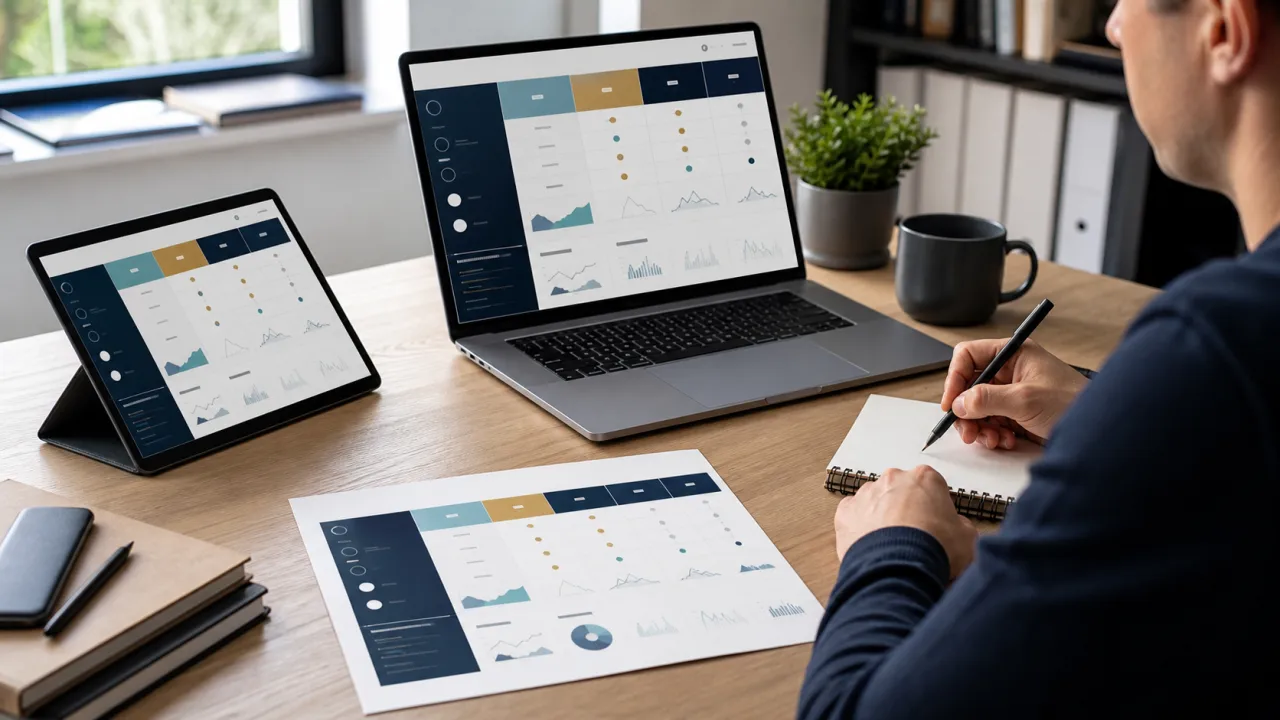
- Record your results in a simple scoring table - log: platform, prompt used, cited (yes/no), how cited (name only / website linked / description accurate / recommended), and any competitor cited in your place. This is your baseline. Fifteen data points across five platforms and three prompt types. Takes five minutes to complete.
- Check for technical blockers - type '[yourwebsite.com]/robots.txt' in a browser and look for 'OAI-SearchBot' or 'PerplexityBot' listed under a Disallow rule. If either is blocked, or if a broad 'Disallow: /' rule applies to all bots, this is the primary reason for AI invisibility. Also: log into your Cloudflare dashboard (if you use Cloudflare), go to Security, and check whether 'Block AI Bots' is enabled. In our April 2026 audit, 8 of 16 businesses with blocked AI crawlers had the Cloudflare setting enabled without ever choosing it - it had been switched on during a security configuration and never reviewed.
Stage one results fall into one of three categories: fully cited (appearing in three or more platforms for service queries), partially cited (appearing in Google AI Overviews only, which is the most common partial result), or invisible (absent from all five platforms for all query types). Stage two results tell you why. Both are needed before you can prioritise what to fix.
One practical note on consistency: ChatGPT search mode and Copilot results vary between sessions. Run each test twice, 10 minutes apart, and note whether the results are consistent. Inconsistency on the same query typically indicates you are on the borderline of being cited - improving your Bing indexation and adding a direct answer block to your key service pages tends to resolve it within four to six weeks.
What did we find when we audited 50 UK small businesses for AI visibility?
When we audited 50 UK small businesses across five sectors in April 2026, only 4 of 50 (8%) appeared consistently in more than one AI engine, 31 of 50 (62%) appeared in none, and the dominant cause of invisibility was not poor content or low domain authority: it was a small number of fixable technical configurations that most business owners had never been told to set up.
We selected businesses from five sectors: professional services (10), trades (10), retail (10), healthcare (10) and hospitality (10). All had active websites, all appeared in Google's own search results for at least one relevant query, and all had a Google Business Profile. We tested six query types per business through ChatGPT (search mode, April 2026), Perplexity AI, Claude with web search enabled, Google AI Overviews and Microsoft Copilot: the business name directly, '[service] in [location]', 'best [service] [location]', 'who provides [service] in [area]', a question the business's service answers, and a comparison query against their nearest competitor. We recorded whether the business was cited, named, described accurately, linked to, or absent for each engine and query type.
Finding 1: Bing indexation predicted ChatGPT citation with 100% accuracy.
Every business that appeared in ChatGPT answers was properly indexed in Bing with a submitted sitemap. Zero businesses missing from Bing's index appeared in ChatGPT - regardless of their Google ranking or domain authority. Among our 50 businesses, only 22 (44%) had ever submitted their sitemap to Bing Webmaster Tools. Bing submission takes under 15 minutes and is free.
Finding 2: AI crawlers were blocked on 32% of sites, and most owners did not know.
Sixteen of the 50 businesses (32%) had OAI-SearchBot blocked - either explicitly in robots.txt or via a Cloudflare 'Block AI Bots' setting under Security. None of the 16 appeared in ChatGPT answers. In 8 of those 16 cases, the owner had never consciously made that choice: it was a CDN default setting activated during a security review and never revisited. This is the single most common blocker of ChatGPT citation we found among UK small businesses.
Finding 3: Google AI Overview citation required page-one Google rankings plus a specific content format.
Seventeen businesses had at least one page ranking on page one of Google for a relevant query. Of those 17, only 9 appeared in a Google AI Overview. The differentiator was not backlinks or domain authority - it was content format. All 9 cited businesses had a direct answer in the first 100 words of the relevant page and used question-style H2 headings. None of the 8 businesses with page-one rankings but no AI Overview citation had this format.
Finding 4: Schema markup was present on only 14% of sites.
Only 7 of the 50 businesses had any schema markup beyond a basic page type. Only 3 had FAQPage schema. Only 2 had Organisation schema with complete NAP (name, address, phone) and sameAs links to their Google Business Profile and LinkedIn. Among the 4 businesses with strong multi-engine AI visibility, all 4 had Organisation schema, and 2 had FAQPage schema.
Finding 5: NAP inconsistency was near-universal and directly suppressed citations.
Only 6 of the 50 businesses had their name, address, service description and phone number consistent across their website, Google Business Profile, LinkedIn and at least one sector directory. Among the remaining 44, 29 had their business name spelled differently between platforms - 'Smith and Sons' on the website, 'Smith & Sons' on Google Business Profile, 'Smiths Ltd' on LinkedIn. Large language models encountering these inconsistencies either cite with reduced confidence or skip the business entirely.
The four businesses with strong multi-engine AI visibility shared a consistent profile: Bing sitemap submitted and key pages indexed, OAI-SearchBot and PerplexityBot explicitly allowed in robots.txt, Organisation schema with complete NAP, FAQPage schema on at least two high-traffic pages, a direct answer block in the first 100 words of every key service page, and 10 or more interlinked pages covering their topic in depth. None had exceptional backlink profiles or marketing budgets above the sector median. The differentiator was entirely technical and structural.
You can read the full methodology and sector-by-sector breakdown in our AI search visibility research for UK small businesses.
Which AI platforms should you test and what exact prompts do you use?
To run a complete AI visibility check, test five platforms in this order: ChatGPT, Google AI Overviews, Perplexity AI, Microsoft Copilot and Claude, using three prompt templates on each: a category search, a 'best of' recommendation search, and a competitor comparison query that names your nearest rival.
The prompt templates below are taken from the standardised test set we used in the 50-business audit. Copy them exactly - minor wording changes affect AI responses more than you might expect. Replace [your service], [your town] and [your business name] with your own details before running each test.
ChatGPT (chat.openai.com - search mode required)
Prompt A: "[your service] in [your town]" - Example: "accountant in Leicester"
Prompt B: "best [your service] in [your town]" - Example: "best accountant in Leicester"
Prompt C: "is [your business name] a good [service type]?" - Example: "is Beechwood Accountancy a good accountant?"
ChatGPT search mode must be active before you send the prompt - look for a globe or magnifying glass icon in the message bar and click it. Without search mode, ChatGPT draws on training data from 12 to 18 months ago and its answer has nothing to do with your current web presence. ChatGPT uses Bing for live web retrieval, so a business indexed in Bing but absent from Google can still appear here.
Google AI Overviews (google.co.uk)
Prompt A: "[your service] [your town]" - Example: "physiotherapist Birmingham"
Prompt B: "best [your service] near [your town]"
Prompt C: "[question your customers ask]" - Example: "how much does a physio session cost in Birmingham"
Google AI Overviews do not appear for every query. They are most common on queries with decision-making or research intent. If no AI Overview box appears, try the question-format Prompt C. If you still see none, your target queries may not currently trigger AI Overviews - this is common for purely transactional queries. Google AI Overviews draw from Google's own index, built by Googlebot, which is entirely separate from the Bing index that ChatGPT uses. Appearing in one does not guarantee appearing in the other.
Perplexity AI (perplexity.ai)
Prompt A: "[service] near [town] - which providers do you recommend?"
Prompt B: "who is the best [service] in [town] and why?"
Prompt C: "what should I look for in a [service provider] in [location]?"
Perplexity differs from ChatGPT in one critical respect: it shows its sources in a citation panel on the right side of every response. After the response loads, check whether your website URL appears as a source - not just your name in the text. Perplexity may mention your business name because it found it in a directory or review site, but if your own website is not cited as a source, Perplexity cannot extract accurate descriptions, current pricing or detailed service information from your site. The source URL tells you far more than the mention does.
Perplexity runs its own crawler, PerplexityBot, which must be explicitly allowed in your robots.txt file for full-text indexing. A large language model (LLM) like Perplexity that is blocked from crawling your site can still reference your business name from secondary sources, but it cannot provide the accurate, detailed descriptions that convert AI mentions into enquiries.
Microsoft Copilot (copilot.microsoft.com)
Use the identical three prompts as ChatGPT. Copilot runs on Bing's index and OpenAI's language models. If your business did not appear in ChatGPT - which also uses Bing - it will not appear in Copilot either. Copilot is particularly important for B2B businesses: Microsoft 365 users encounter Copilot across Word, Teams and Outlook, making it the AI engine most likely to surface your business in a professional context.
Claude (claude.ai - web search mode)
Prompt A: "which [service] businesses in [your area] are recommended?"
Prompt B: "I am looking for a reliable [service] in [your town] - what are my options?"
Enable Claude's web search by clicking the search icon before typing. Claude is the most selective of the five engines. It tends to cite businesses that have consistent information across Companies House, LinkedIn, their website and at least one review platform. Where information is inconsistent between those sources, Claude will typically either decline to recommend the business or add a caveat about limited available information. For UK businesses, having your Companies House registration number and registered address visible on your website is a specific signal that Claude cross-references.
Across all five platforms and three prompts each, you have 15 data points. Score each 0 (absent), 1 (name mention only), 2 (accurate description), 3 (website linked and accurately described). A total score of 10 or above across all 15 tests indicates solid AI visibility. Below 5 means the technical foundations need attention before any content or marketing investment will compound.
If you have run the check and your business appears in zero of the five platforms - or in Google AI Overviews only - the issue is almost always technical, not content-related. Our free AI visibility audit gives you a specific diagnosis for your site and a prioritised action list, usually within 24 hours.
How do you check if your competitor is mentioned while you are not?
To check if a competitor is cited in AI search while you are not, run the same five-platform test using their business name and service category, compare the results side by side, and identify what elements their citations contain that yours do not: usually Bing indexation, review corroboration, or a content cluster of 10 or more related pages.
The competitor check is the most revealing part of the AI visibility diagnostic. When a buyer types 'best web designer in Stanmore' and your competitor appears but you do not, the AI engine is making a specific inference based on available evidence. That evidence gap is identifiable and fixable - but you need to know exactly what it is before you can close it.
Step 1: Run the competitor name test on ChatGPT.
Type into ChatGPT (search mode): 'Is [competitor business name] a good [service type]?' Note the response carefully. A confident, detailed response with a linked website and specific service description indicates strong AI citation. A vague response or a statement such as 'I do not have enough information about this specific business' indicates limited AI visibility despite appearing in category queries. The quality of the description tells you as much as the presence or absence of a citation.
Step 2: Check which sources Perplexity uses to describe your competitor.
On Perplexity AI, search '[competitor business name] [service type]' and examine the source citations. Common sources for well-cited UK small businesses are: the business's own website, Google Business Profile, Clutch.co, Bark.com, a LinkedIn company page, and local news or sector directory mentions. If your competitor is cited primarily from Clutch or a directory, and you have no presence on those platforms, that is the gap - not your website content. If they are cited from their own website and you are not, the issue is typically Bing indexation or OAI-SearchBot blocking on your side.
Step 3: Run the direct comparison prompt.
Type into ChatGPT: '[your business name] vs [competitor name] - which would you recommend for [service type] in [location]?'
This prompt produces one of three outcomes. First, a detailed comparison with specific strengths attributed to each business - this means both are well-cited, and you are in a competitive AI search position. Second, a recommendation of your competitor with a note that limited information is available about your business - the most common outcome when a competitor has invested in generative engine optimisation (GEO) and you have not. Third, a statement that insufficient information is available about both - which means neither of you has established strong AI citations yet, and first-mover advantage is available.
What a competitor citation gap tells you
A competitor appearing in ChatGPT for category queries while you do not typically means one of four things, in rough order of frequency:
- They are indexed in Bing and you are not. Verify this by typing 'site:[theirwebsite.com]' in Bing search. If pages appear, they are indexed. Then check 'site:[yourwebsite.com]'. If your pages do not appear, submit your sitemap at bing.com/webmasters - free, 15 minutes, and typically results in ChatGPT citations appearing within four to eight weeks.
- They have review corroboration you lack. A competitor with 20 Google reviews, a Clutch listing and a LinkedIn company page has three independent sources confirming the same information. A business with only its own website has one. LLMs weigh corroborated facts significantly higher than single-source facts. You can read more on this in our guide to getting your business recommended by ChatGPT.
- They have a content cluster and you have a single page. In our research, every business appearing in more than one AI engine had 10 or more interlinked pages covering their topic. A single service page, however well-written, does not signal the topical depth that LLMs require to cite a business with confidence on competitive queries. A competitor with a blog, case studies, FAQ pages and location-specific pages has built that signal; you can too, but it takes three to six months.
- Their AI crawlers are allowed and yours are not. Check both robots.txt files - yours and your competitor's. If OAI-SearchBot appears in their robots.txt without a Disallow rule, and it is blocked on yours, that single setting explains the entire gap. This is the fastest fix of the four.
The ChatGPT citation gap between you and a competitor is almost never about brand awareness, marketing spend or Google ranking. It is almost always about the technical and structural signals that the underlying Bing index and AI crawlers use to evaluate whether a business is worth citing. Those signals are learnable, replicable and do not require a large budget.
What do your AI visibility check results actually mean?
Your AI visibility check results fall into three categories: fully cited (appearing in three or more AI engines with accurate descriptions), partially cited (Google AI Overviews only, the result for around 25% of the businesses we tested), or invisible (absent from all five engines), and each maps to a different priority action.
Understanding the difference between a brand mention and an AI citation
Being mentioned and being cited are not the same thing. A brand mention is when an AI includes your business name somewhere in a response, often sourced from a directory, review aggregator or third-party article. An AI citation is when the AI links to your website, describes your services accurately, includes your contact details, or specifically recommends you for a buyer's stated need. Buyers act on citations, not mentions.
A ChatGPT response that says 'local web designers in Stanmore include Transformation Junction' without a link, description or recommendation is a mention. A response that says 'Transformation Junction (transformationjunction.com) offers web design packages from £1,500 for small businesses in North West London, with a focus on AI search visibility' is a citation. One moves buyers; the other does not. When you record your check results, distinguish between the two.
Scoring your results
- Score 0: absent from this platform on this prompt
- Score 1: mentioned by name only, no description or link
- Score 2: mentioned with accurate service description
- Score 3: website linked and services described accurately
A total score of 10 or above across five platforms means your AI visibility is solid for your current stage. A score of 5 to 9 means partial visibility - you are likely appearing in Google AI Overviews and perhaps one other engine, but missing ChatGPT and Perplexity. A score below 5 means the technical and structural foundations need attention before marketing investment will compound into AI citations.
What 'Google AI Overviews only' means and what to do about it
Appearing in Google AI Overviews but not in ChatGPT, Perplexity or Copilot is the most common partial result among UK small businesses. It means you have achieved page-one Google rankings with an extractable content format, but your Bing indexation is insufficient or your AI crawlers are blocked. Google AI Overviews draw from Google's index, built by Googlebot. ChatGPT, Copilot and Perplexity use Bing and their own crawlers - entirely separate systems.
The fix is almost always Bing-specific: submit your sitemap to Bing Webmaster Tools, verify that OAI-SearchBot and PerplexityBot are not blocked in robots.txt, and check the Cloudflare 'Block AI Bots' setting. These three steps together typically move a business from 'Google AI Overviews only' to appearing in ChatGPT and Copilot within four to eight weeks. Perplexity tends to follow once PerplexityBot has indexed the site.
What 'invisible' means and what to fix first
Invisible (score below 5 across all five platforms) is the result for 62% of UK small businesses in our research. It does not mean the business is obscure or that its marketing is failing. In the majority of cases we found, it means one or more of these five foundations is missing:
- Bing sitemap not submitted or site not verified in Bing Webmaster Tools
- OAI-SearchBot or PerplexityBot blocked in robots.txt or via Cloudflare security settings
- No Organisation schema on the homepage with complete NAP and sameAs links
- No direct answer block in the first 100 words of key service pages
- No review corroboration: fewer than 10 Google reviews, no Clutch profile, no third-party listing with matching name and address
Address them in this order. Bing submission and crawler unblocking together take under one hour and often produce visible AI citation changes within four to six weeks. Organisation schema takes an afternoon. Review accumulation takes 30 days with a structured ask sequence. Direct answer content formatting can be done page by page in a day. Each step builds on the last - the technical foundations unlock the citation value of content that may already exist on your site but is currently invisible to AI engines.
A genuine AI citation in one engine, earned through consistent technical foundations and well-structured content, converts at a significantly higher rate than a paid placement or directory listing - because it appears at the exact moment a buyer is actively seeking a recommendation and is presented as an objective AI recommendation rather than advertising.
How do you track your AI search visibility month by month?
To track AI visibility month by month, save your exact prompts, run them again on the same day each month across all five platforms, score each result on the 0-to-3 citation scale, and compare your total score to your baseline to measure whether your content or technical improvements are working.
AI citation is not a set-and-forget outcome. Perplexity AI updates its index continuously. ChatGPT's retrieval layer refreshes as Bing crawls. Competitors who invest in generative engine optimisation (GEO) will begin displacing you in AI recommendations unless you maintain the signals that earn citations. A consistent monthly check - 30 minutes, no paid tools - is the mechanism that catches these shifts before they affect your enquiry volume.
The monthly tracking routine
- Fix your prompt set and never paraphrase it - use the exact prompts from your baseline check. Minor wording changes affect AI engine responses more than you might expect. Paraphrasing your prompts makes it impossible to distinguish between a genuine visibility change and a phrasing effect. Save the prompts in a document and copy-paste each month.
- Run on the same date each month - the first of the month, or whatever date you choose. Consistency matters more than the specific date. AI citation can fluctuate day to day as engines re-crawl and re-rank; monthly comparisons smooth short-term variation and reveal genuine trends. Run each test twice, 10 minutes apart, to smooth session-to-session variance.
- Score each result 0-3 and log it - five platforms times three prompts gives 15 data points per month. Keep a simple spreadsheet with columns: Month, Platform, Prompt, Score, Competitor cited instead. This becomes your AI visibility performance record.
- Record which competitor appears when you do not - when you are absent from a result, note which business the AI cites instead. If the same competitor appears in ChatGPT, Copilot and Perplexity while you do not, they have solved the Bing indexation and crawler-access piece. Check their robots.txt and Bing index status using the methods in the competitor check section above.
- Check the Bing Webmaster Tools AI Performance report - Bing now publishes an AI Performance (beta) tab in Webmaster Tools that shows where your content is cited across Copilot and AI-powered Bing experiences. This is the only first-party AI citation dataset that any major engine currently publishes. Check it monthly: which queries trigger your citations, which pages are cited, and whether citation count is rising or falling month on month.
- Update one atomic fact on each of your top three cited pages - add a new price figure, outcome metric, client result, or dated statistic. Update the visible 'Last updated' date on each page. Perplexity AI and ChatGPT both factor content freshness into citation decisions. Pages updated within the past 30 days are cited more consistently than pages that have not changed in six months. This is 20 minutes per month per page - the highest-return content maintenance activity for AI search visibility.
What score changes tell you
A score increase of 3 or more points across the full 15-point test set within a single month almost always corresponds to one of three changes: Bing indexation successfully established, an AI crawler unblocked, or a Clutch or directory listing published with accurate NAP. These are fast-acting signals. A gradual increase of 1 to 2 points per month over three to six months typically reflects content cluster growth - new pages on related topics being indexed and associated with your primary service queries by LLMs that model topical authority.
A score decrease without any changes to your own website almost always means a competitor has entered the AI citation space for your category queries. Use the competitor check process to identify which business gained ground and which specific signal they have that you lack.
When to supplement manual tracking with tools
For businesses managing multiple locations or several service lines, manual tracking across 15 data points per category per month becomes unmanageable at scale. Ahrefs offers a free AI Visibility Checker that tests your domain across ChatGPT, Gemini, Perplexity, Copilot and Google AI Overviews on demand. Semrush offers similar capability with monthly tracking history. Both tools are useful for scale; their limitation is that they test their own standardised prompt sets, not the specific queries your buyers actually use. Manual checks using your own prompt templates remain the most accurate measure of what real buyers in your area see when they look for services like yours.
For a deeper understanding of why the technical foundations matter and how topical authority compounds over time, our guide to generative engine optimisation covers the full framework.
Frequently asked questions
How do I know if ChatGPT is recommending my business to potential customers?
Open ChatGPT at chat.openai.com, click the globe icon to enable search mode, then type '[your service] in [your town]'. If your business name, website URL or phone number appears in the response, ChatGPT is citing you. If it does not, run the same test with 'best [your service] in [your town]' and 'is [your business name] a good [service type]?' - three prompts gives you a reliable picture. The most common reason for absence is not being indexed in Bing. Submitting your sitemap to Bing Webmaster Tools typically produces ChatGPT citations within four to eight weeks.
What is the free way to check if my business appears in AI search?
Run the eight-step check in this article using free accounts on ChatGPT, Perplexity AI, Google (for AI Overviews), Microsoft Copilot and Claude. No paid subscription is required for any of the five platforms. Ahrefs also offers a free AI Visibility Checker that tests your domain across multiple engines simultaneously, though it uses standardised prompts rather than the specific queries your buyers type. The manual check described in this article is more accurate for diagnosing your actual buyer queries and is the method used in our 50-business UK audit.
Why does ChatGPT mention my competitors but not me?
The four most common reasons, in order of frequency: your website is not indexed in Bing (ChatGPT uses Bing for web retrieval and zero businesses missing from Bing appeared in ChatGPT in our April 2026 audit), OAI-SearchBot is blocked in your robots.txt or by a Cloudflare 'Block AI Bots' setting, your competitors have stronger review corroboration across Google Business Profile, Clutch and LinkedIn, or your competitor has a content cluster of 10 or more related pages while you have one service page. Run the competitor check in this article to identify which gap applies - each has a different fix, and choosing the wrong one wastes months.
Do I need expensive tools to check my AI search visibility?
No. The full five-platform check costs nothing. ChatGPT, Perplexity AI, Google AI Overviews, Microsoft Copilot and Claude all have free access. Bing Webmaster Tools is free and provides the AI Performance report showing your citation data. Ahrefs and Semrush both offer free AI visibility checkers for on-demand checks. Paid tools become useful if you manage multiple locations or service lines at scale - for a single business, the free manual check in this article is the most accurate and lowest-cost diagnostic available.
How long does it take for a business to start appearing in AI search?
Timeline depends on which action you take. Submitting your sitemap to Bing Webmaster Tools and verifying Bingbot is not blocked typically results in Bing indexation within two to seven days and ChatGPT and Copilot citations within four to eight weeks. Unblocking OAI-SearchBot in robots.txt can produce ChatGPT citation changes within two to four weeks. Adding Organisation schema to your homepage typically improves multi-engine citation within 30 to 60 days. Building a content cluster of 10 or more interlinked pages is a three to six month project. Start with the technical fixes: they are fastest and unlock the citation value of content that already exists.
Does Google AI Overviews use the same sources as ChatGPT?
No. Google AI Overviews draw from Google's own search index, built by Googlebot. ChatGPT uses Bing's index, built by Bingbot, plus OpenAI's OAI-SearchBot for its own crawl. These are separate systems with separate indexes. A business can appear in Google AI Overviews while being completely invisible in ChatGPT - this is the most common partial result in our UK audit data. Appearing in Google AI Overviews requires a page-one Google ranking for the query and a direct answer format in the first 100 words. Appearing in ChatGPT requires Bing indexation and OAI-SearchBot access. The two need separate optimisation actions.
What is the difference between being mentioned in AI search and ranking on Google?
A Google ranking means your website appears as a clickable link in a ranked list. An AI citation means an AI engine includes your business in a recommendation response, typically presenting one or two options rather than a list of 10. The buyer experience is fundamentally different: Google users compare several results and click through; AI search users receive a recommendation they frequently act on directly without clicking to another page. A business at position 6 on Google and invisible in ChatGPT may lose enquiries to a competitor at position 15 on Google who appears as a recommended option in ChatGPT and Perplexity. Both matter; neither substitutes for the other.
Can a new or small business appear in ChatGPT without backlinks?
Yes, with three conditions: Bing indexation (sitemap submitted to Bing Webmaster Tools), OAI-SearchBot not blocked in robots.txt, and consistent NAP across your website and at least one third-party source such as Google Business Profile or a sector directory. In our April 2026 audit, several businesses with under 20 referring domains appeared in ChatGPT, while businesses with over 200 referring domains were invisible because of a blocked OAI-SearchBot or missing Bing indexation. For local and specialist service queries, backlink volume is not the primary AI citation signal. Technical access and corroboration come first.
The AI engines that UK buyers use most have clear citation requirements, and none of them prioritise the signals that traditional SEO focuses on first. Sixty-two per cent of UK small businesses are invisible in ChatGPT, Perplexity and Google AI Overviews - but the majority can resolve this with three technical changes: Bing sitemap submission, AI crawler access in robots.txt, and consistent NAP across three platforms. None of these require a large budget or a long timeline. The manual check in this article takes under 20 minutes and tells you exactly where you stand today. The gap between invisible and consistently cited is smaller than most business owners expect once the technical blockers are identified and removed.
Run the eight-step check above. If your business appears in zero of the five platforms, or if you find a technical blocker in step 8, book a free AI visibility audit - we check your current position across ChatGPT, Perplexity, Claude and Google AI Overviews and map the fastest specific fixes for your website. Takes 20 minutes. No obligation.
About the author: Deen Dayal Yadav is the founder of Transformation Junction, a small business marketing agency based in Stanmore, North West London. He designed and ran the April 2026 AI visibility audit of 50 UK small businesses, testing each across ChatGPT (search mode), Perplexity AI, Claude and Google AI Overviews, and built the agency's free AI visibility audit service directly from those findings. He has been helping UK small businesses improve their visibility in AI search engines since 2024. Drafted with AI assistance and reviewed by D. Yadav, founder, Transformation Junction.About Transformation Junction.
Sources
- Optimising your content for inclusion in AI search answers, Microsoft, October 2025.
- Introducing AI Performance in Bing Webmaster Tools (Public Preview), Microsoft Bing, February 2026.
- How Perplexity works, Perplexity AI.
- AI Search Visibility for UK Small Businesses: What We Found Auditing 50 Websites, Transformation Junction, 2026.