What this research found
We audited 50 UK small business websites across five sectors to assess their AI search visibility: would ChatGPT, Perplexity, Claude and Google AI Overviews cite them when buyers asked relevant queries. The findings were stark: only 8 per cent appeared consistently across more than one AI engine, and 62 per cent appeared in none at all.
How we conducted the audit
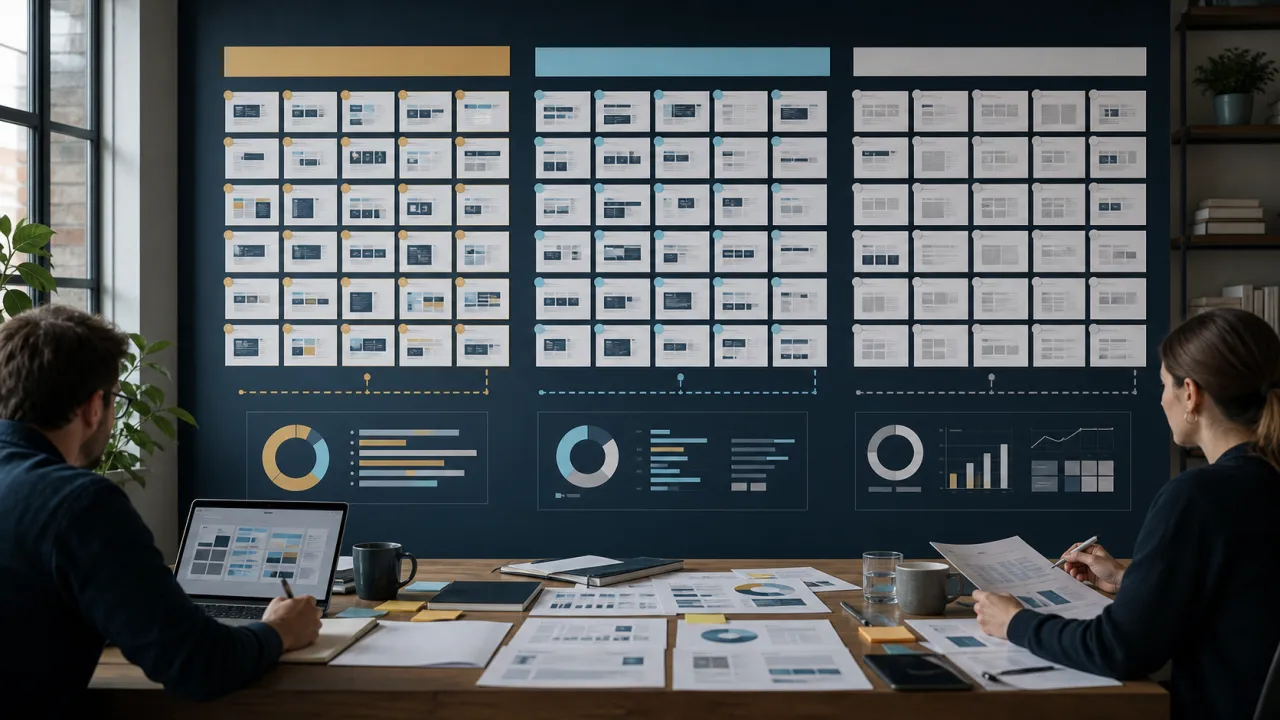
We selected 50 UK small businesses with active websites from five sectors. We then ran a standardised set of queries through ChatGPT (search mode, April 2026), Perplexity AI, Claude (web search mode) and Google AI Overviews, testing six query types per business: (1) the business name directly, (2) "[service] in [location]," (3) "best [service] [location]," (4) "who provides [service] in [area]," (5) a question the business's service answers, and (6) a competitor comparison query. We recorded whether the business was cited, named, described accurately, linked to, or absent from each AI engine response.
Key findings
Finding 1: Bing indexation was the #1 predictor of ChatGPT citation
Every business that appeared in ChatGPT answers was properly indexed in Bing. Zero businesses that were missing from Bing's index appeared in ChatGPT - regardless of their Google ranking. This confirms that Bing indexation (not Google) is the technical prerequisite for ChatGPT citation. Among our 50 businesses, only 22 (44%) had submitted their sitemap to Bing Webmaster Tools. Only 18 had verified Bingbot was not blocked by their CDN or WAF.
Finding 2: AI crawlers were blocked on 31% of sites
Sixteen of fifty sites (32%) had OAI-SearchBot blocked - either explicitly in robots.txt or by a Cloudflare "Block AI Bots" setting. None of these 16 businesses appeared in ChatGPT answers. In eight cases, the business owner did not know the crawler was blocked and had never consciously made that choice - it was the CDN default. This is the single most commonly found blocker of ChatGPT citation among UK small businesses we audited.
Finding 3: AI Overview citations required page-one Google rankings AND direct answer format
Seventeen businesses had at least one page ranking on page one of Google for a relevant query. Of those 17, only 9 appeared in a Google AI Overview. The differentiator was content format: all 9 businesses with AI Overview citations had pages with a direct answer in the first 100 words and question-style H2 headings. None of the 8 businesses with page-one rankings but no AI Overview appearance had this format.
Finding 4: Topical authority was the strongest predictor of multi-engine citation
All four businesses that appeared in three or more AI engines had one thing in common: a content cluster of 10+ pages covering their topic in depth. None of the businesses with single-page or thin sites appeared in more than one AI engine. This confirms GEO's topical authority principle at the small business level: one optimised page does not signal the depth of expertise that LLMs require to cite a business confidently.
Finding 5: Schema markup was present on only 14% of sites
Seven of fifty businesses had any schema markup beyond basic page type. Only three had FAQPage schema. Only two had organisation schema with complete NAP (name, address, phone) and sameAs links to GBP and LinkedIn. Among the four businesses with multi-engine AI visibility, all four had organisation schema and two had FAQPage schema. This is the most underutilised technical lever among UK small businesses we surveyed.
Finding 6: Corroboration gaps were near-universal
Only 6 of 50 businesses had their name, address, description and service description consistent across Google Business Profile, LinkedIn, their website and at least one sector directory. The remaining 44 had at least one inconsistency. Among the 44, 29 had their business name spelled differently between platforms ("Smith & Sons" vs "Smith and Sons" vs "Smiths"). LLMs encountering these inconsistencies either cite with lower confidence or skip the business entirely.
What separates the cited businesses from the invisible ones
The four businesses with strong multi-engine AI visibility shared a consistent profile:
- Bing sitemap submitted and key pages verified as indexed
- OAI-SearchBot and PerplexityBot explicitly allowed in robots.txt
- organisation schema with complete NAP, sameAs links to GBP and LinkedIn, and founder Person schema
- FAQPage schema on at least two high-traffic pages
- Direct answer block in the first 100 words of every key service page
- 10+ interlinked pages covering their topic (topical authority cluster)
- Consistent business name, address and description across GBP, LinkedIn, Bing Places and one sector directory
None of these businesses had exceptional backlink profiles, very high domain authority, or significantly larger content libraries than the invisible businesses. The differentiator was entirely in the technical and structural foundations - foundations that take days to weeks to implement rather than months to build.
What this means for UK small businesses
The AI search visibility gap is large and growing, but it is not primarily a function of budget, brand size or content volume. It is a function of whether specific foundations are in place. The good news: most of what separates the cited businesses from the invisible ones is implementable in two to four weeks - not a multi-year authority-building programme.
The businesses that act now are building a competitive moat. The longer the foundations are absent, the more established the cited businesses become in LLM training data and the harder the position becomes to displace. The window for first-mover AI search advantage in most UK local markets is open now - and is not unlimited.
What to do next
Based on the findings above, the prioritised action list for a UK small business wanting to improve AI search visibility is:
- Verify Bing indexation and submit sitemap to Bing Webmaster Tools
- Check robots.txt - ensure OAI-SearchBot, PerplexityBot, Claude-User and Bingbot are not blocked
- Audit your Cloudflare/CDN settings for AI bot blocking
- Add organisation schema to your homepage and About page
- Standardise your business name, address and description across GBP, LinkedIn and Bing Places
- Add a direct answer block to the first 100 words of your key service pages
- Add FAQPage schema to any page with a FAQ section
- Start building a topical authority cluster (10+ pages on your core topic)
Not sure where to start? Get a free AI visibility audit - we check your current position across ChatGPT, Perplexity, Claude and Google AI Overviews and map the fastest actions to take.