
Solicitor web design costs £3,000 to £10,000 in the UK for a single practitioner or small firm, and the design work that changes commercial outcomes is establishing verifiable trust before the first phone call rather than styling the brand or refining the photography.
Legal clients arrive in difficulty, comparing two or three firms, and they decide on evidence: a named solicitor with an SRA number and admission year, a plainly stated fee, and content proving the firm has handled their exact situation before. SRA Transparency Rules require published price information for several common work types, so the the regulatory obligation and the conversion lever are the same content placed well. Ongoing hosting, maintenance and security typically add £40 to £150 monthly on top of the build.
Last updated: 22 August 2026
A solicitor website has a narrower job than most professional service sites. It does not need to build a brand or tell a story. It needs to convince someone who is worried, often at an inconvenient hour, that this firm handles their kind of problem competently and will not surprise them with the bill.
- How much does a solicitor website cost?
- What builds trust on a solicitor website?
- How should a small firm compete with larger practices?
- What should a solicitor publish about fees?
- How should a solicitor website handle sensitive practice areas?
- What accessibility requirements apply?
- How should a sole practitioner approach the website?
- What content should a solicitor website publish?
- How should a solicitor website capture out-of-hours enquiries?
- How should a solicitor website handle client reviews?
- How should a solicitor measure whether the website works?
- Frequently asked questions
- Related reading
How much does a solicitor website cost?
A solicitor website costs £3,000 to £10,000 in the UK. A sole practitioner needing six to eight pages sits at £3,000 to £5,000. A small firm with several practice areas and fee-earner profiles sits at £5,000 to £10,000. Ongoing hosting, maintenance and security typically add £40 to £150 monthly.
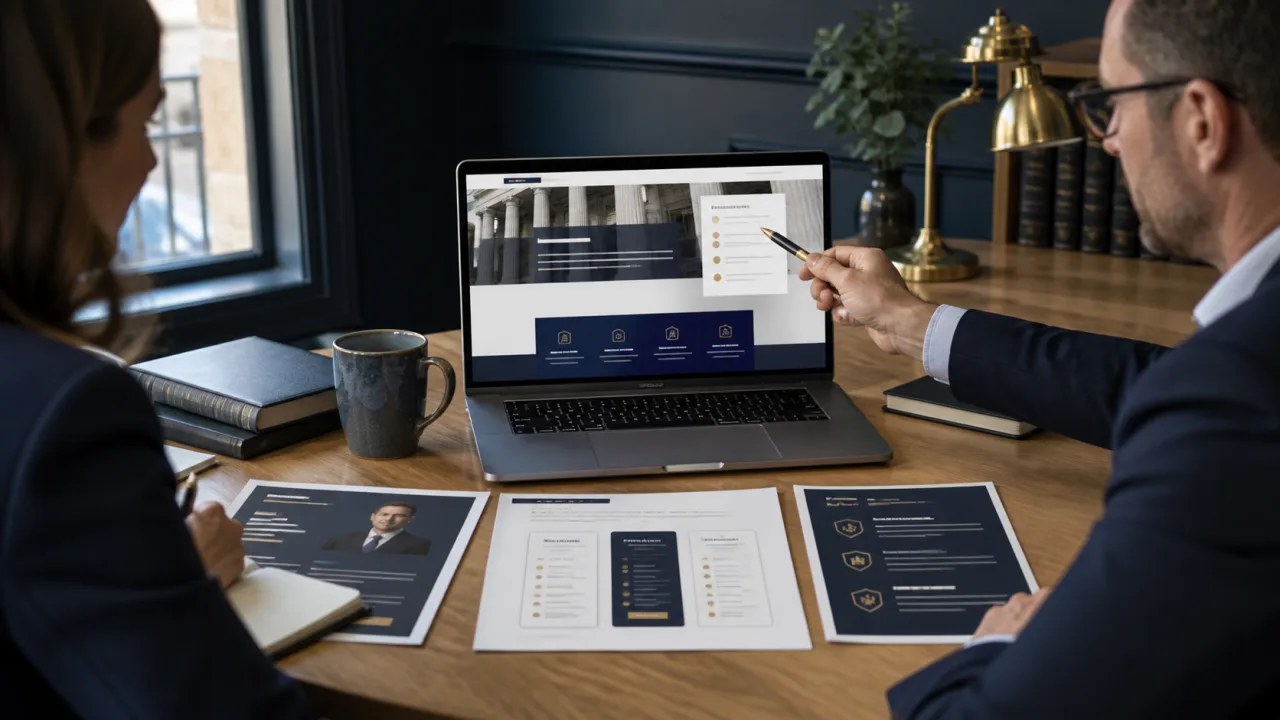
Content preparation drives both the cost and the timeline. Fee-earner biographies, practice-area copy and the transparency information the SRA requires all need input from people billing by the hour, which is why legal website projects overrun more often than most.
| Firm type | Typical cost | Build time | Core requirement |
|---|---|---|---|
| Sole practitioner | £3,000-£5,000 | 3-6 weeks | 1-2 practice areas, SRA badge, fee basis |
| Small firm, 2-5 fee earners | £5,000-£8,000 | 6-10 weeks | Practice-area pages, solicitor profiles |
| Multi-office firm | £8,000-£10,000 | 10-14 weeks | Office pages, full fee-earner directory |
| Ongoing hosting and maintenance | £40-£150 monthly | n/a | Security, backups, content changes |
What builds trust on a solicitor website?
Verifiable specifics build trust: the SRA number, the solicitor name and admission year, the regulated status statement, and evidence of handling the visitor exact situation. Claims of being approachable and experienced build nothing, because every competing firm makes them.
The asymmetry is worth understanding. A prospective client cannot assess legal skill, so they assess proxies for it. An SRA number they can check on a public register is a proxy. A named solicitor with a stated admission year is a proxy. A page describing exactly how a boundary dispute proceeds, with realistic timescales and costs, is a proxy that also demonstrates the knowledge it describes.
Should a solicitor website show photographs of the team?
Genuine photographs of the actual solicitors outperform stock imagery substantially, because legal clients are choosing a person as much as a firm. Stock photographs of models in suits signal the opposite of the transparency the page is trying to establish.
Quality matters less than authenticity here. A competent photograph taken in the actual office does more than an expensive shoot that looks like a stock library. Clients meeting a solicitor having seen their photograph arrive with a sense of familiarity that shortens the trust-building part of the first meeting.
How should a small firm compete with larger practices?
Small firms compete on specificity and accessibility rather than breadth. A two-partner firm cannot outrank a national practice for general terms, but it can own a specific practice area in a specific area, with more depth than a large firm bothers to publish.
Direct access is a genuine advantage worth stating explicitly. Many clients of larger firms deal with a paralegal and rarely speak to the named solicitor. A small firm where the client speaks to the solicitor handling the matter should say so plainly, because it addresses a real and common frustration.
If your firm is competing on generic terms and losing, narrowing is usually the answer rather than spending more. Our AI SEO service works with smaller firms on exactly this: choosing a defensible position instead of a contested one.
What should a solicitor publish about fees?
Publish the fee basis for every practice area and the full transparency information the SRA requires for the specified work types. Fixed fees where offered, hourly rates with an estimate of hours where not, and disbursements listed separately.
Clients fear the open-ended bill more than the headline rate. A page explaining that a matter is charged at a stated hourly rate, typically taking a given range of hours, with a written estimate provided before work begins, addresses that fear directly. A page saying fees depend on circumstances confirms it.
How should a solicitor website handle sensitive practice areas?
Sensitive practice areas need plain language, discretion and a private contact route. Someone researching domestic abuse, criminal defence or a child arrangement matter may be doing so on a shared device and needs the page to be useful without being conspicuous.
- Write in plain language - avoid legal terminology in headings and opening paragraphs, since someone in crisis is not searching in statutory terms.
- Offer a discreet contact route - a phone number and an email address rather than only a form, and state whether calls can be returned at a chosen safe time.
- State cost early - financial fear compounds the situation, and legal aid availability or fixed-fee options should be visible rather than buried.
- Link to independent support - naming relevant national organisations helps the reader and signals genuine familiarity with the area.
- Set out the first step - describing what happens in the first appointment removes a barrier for people who have never instructed a solicitor.
What accessibility requirements apply?
Legal services websites should meet WCAG 2.2 AA. The Equality Act 2010 requires service providers to make reasonable adjustments for disabled people, and an inaccessible website that prevents someone accessing legal services is a foreseeable failure to do so.
Accessibility overlaps heavily with legal client need. Clients with visual impairments, cognitive difficulties or English as a second language all benefit from clear headings, sufficient contrast, keyboard navigation and plain language. The same measures improve comprehension for a stressed client reading at midnight.
How should a sole practitioner approach the website?
A sole practitioner should build a small, specific site rather than imitating a larger firm. Six to eight pages covering one or two practice areas properly, with the solicitor named throughout, outperforms twenty thin pages implying a bigger operation.
Overstating scale is a common and avoidable error. Referring to our team and our offices when the practice is one person working from a serviced office creates a mismatch the client discovers at the first meeting. Sole practice is an advantage for many clients, who want continuity and direct access, and stating it plainly attracts the people who want exactly that.
Concentration also suits the budget. A sole practitioner spending £4,000 on a focused site covering two practice areas thoroughly gets a better return than the same budget spread across six areas the practitioner rarely handles.
What content should a solicitor website publish?
Solicitor websites gain most from process guides, timescale content and cost explanations for their specific practice areas. These are the questions clients ask in the first meeting, which means answering them publicly attracts people at exactly the point they are choosing a firm.
Process guides work because legal procedure is opaque to almost everyone using it. Someone facing their first tribunal claim, probate application or boundary dispute has no idea what happens, in what order, or how long it takes. A guide setting out the stages with realistic timescales is genuinely useful and demonstrates competence more convincingly than any claim.
Timescale content deserves separate treatment because waiting is what clients find hardest. How long probate takes before funds are released, how long a tribunal claim waits for a hearing, how long conveyancing runs. Publishing honest ranges, including the factors that extend them, builds more trust than quoting the best case and disappointing later.
What should a solicitor avoid publishing?
Avoid general legal news commentary, which competes against national publishers and legal press with no realistic prospect of ranking and no commercial value if it did. Legislative summaries written for other lawyers attract other lawyers.
Avoid also the appearance of giving specific advice. Content should explain how a process works in general terms and direct the reader to take advice on their own circumstances. Pages reading as tailored advice create professional risk and can imply a retainer that does not exist.
How should a solicitor website capture out-of-hours enquiries?
Legal enquiries arrive disproportionately outside working hours, because people research problems when they finally have time to think about them. A site that only offers a nine-to-five phone number loses the enquiry to a firm that offered another route.
A callback request with a chosen time slot handles this better than a generic contact form. It gives the visitor a concrete commitment rather than an open-ended wait, and it lets the firm manage the response within normal hours without losing the enquiry to a competitor overnight.
Response time should be stated and then honoured. A firm promising a response within one business day and delivering it consistently outperforms a firm promising an immediate response and missing it, because the second creates a broken expectation at the most anxious moment of the relationship.
How should a solicitor website handle client reviews?
Legal reviews need care because confidentiality binds the firm even when the client speaks freely. A firm may invite reviews, but its responses must never confirm that someone was a client or reference any matter detail.
Review platforms carry different weight in legal services than elsewhere. Google reviews drive local visibility, while the Law Society Find a Solicitor listing and independent legal directories carry professional credibility. A firm benefits from presence across both, since prospective clients frequently check more than one.
Negative reviews require particular discipline. The instinct to correct the record publicly conflicts directly with confidentiality obligations, and a defensive response that reveals matter detail is a regulatory problem far larger than the original complaint. A short reply offering to discuss the matter through a named contact, without confirming any relationship, is the safe and more persuasive response.
Should a firm display awards and accreditations?
Display accreditations that carry independent verification, such as Law Society accreditation schemes, Lexcel, or specialist panel memberships. These are checkable and mean something to clients researching whether a firm is credible.
Paid awards carry little weight and can undermine credibility with informed clients. A firm displaying a logo from an awards scheme that charges for entry alongside a genuine Law Society accreditation dilutes the second. Independent verification is the test worth applying before anything goes on the page.
How should a solicitor measure whether the website works?
Measure enquiries by practice area and source rather than visits or rankings. The commercially useful question is which pages produce enquiries that convert into instructions, and answering it needs the website connected to the firm enquiry record.
Most firms cannot answer that question. They know roughly how busy they are and roughly what the website costs, but not which pages produce work. Recording the source at first contact, even in a spreadsheet, produces a usable answer within a quarter and costs nothing beyond the discipline of asking.
Conversion rate matters more than traffic volume for legal services, because legal search volumes are modest and intent is high. A practice-area page receiving forty visits a month and producing four enquiries is performing better than one receiving four hundred visits and producing two. Optimising for visits rather than enquiries pushes firms toward broad informational content that attracts readers who will never instruct anyone.
What should a firm do with pages that produce nothing?
Pages producing no enquiries after six months should be improved, merged or retired rather than left in place. Thin practice-area pages covering work the firm rarely does dilute the site and compete against the pages that matter.
Improvement usually beats deletion where the practice area is genuinely offered. A page failing to convert often lacks the fee information, named solicitor or process detail that the converting pages carry, and adding those is faster than starting again. Retirement is right where the firm no longer does the work at all, in which case the page should redirect to the closest relevant practice area rather than returning a not-found error.
Frequently asked questions
Does a solicitor need a separate site for each practice area?
No. Separate pages within one site are correct. Separate domains split authority, multiply maintenance and create compliance duplication. One site with well-structured practice-area pages performs better and costs less to run.
Can a solicitor publish case results?
With care. Results must not imply that similar outcomes are guaranteed, which would breach the SRA requirement not to mislead, and client consent is needed. Anonymised process descriptions are usually safer and nearly as persuasive.
Should a solicitor website include live chat?
Only with genuine capacity to answer. An unmonitored chat widget raises an expectation of immediate help and then fails it, which is worse than not offering it. Clear phone hours and a callback commitment serve most firms better.
What is the SRA digital badge?
The SRA digital badge is a verification tool firms must display, confirming regulated status and linking to the firm's entry on the SRA register. It is a requirement rather than an optional trust marker.
How long should practice-area pages be?
Long enough to answer the questions a client has before instructing: process, timescale, cost and who handles it. That usually runs to several hundred words. Length itself is not the objective; unanswered questions are the problem to solve.
Should a small firm invest in a website or in Google Ads?
The website first, because ads send traffic to it and a weak site wastes that spend. Once practice-area pages state fees and name solicitors, paid traffic converts far better and the same pages continue working organically.
Related reading
Solicitor web design costs £3,000 to £10,000 in the UK, with content preparation driving both cost and timeline. Legal websites convert on verifiable specifics rather than design: the SRA number and digital badge, named solicitors with admission years, and fee information published as fixed prices or hourly rates with estimated hours. SRA Transparency Rules already require price publication for several common work types, so compliance and conversion are served by the same content. Small firms compete by narrowing rather than broadening, owning a specific practice area with more depth than larger firms publish. Sensitive practice areas need plain language, a discreet contact route and early cost information.
Website not converting the enquiries you expect? We review solicitor websites against SRA transparency requirements, trust signals and conversion path. See our web design service or book a call.
Written by the Transformation Junction SEO team. Cost figures are market estimates drawn from published UK agency pricing, not measured client data; regulatory and platform requirements are sourced below. Drafted with AI assistance and reviewed by a named editor before publication; see our editorial policy on the About page.
Sources